Custom Qi2 Magnetic Ring Solutions for Stable Wireless Charging


Quick Answer: What Makes a Reliable Qi2 Magnetic Ring?
What Is a Qi2 Magnetic Ring Assembly?
Why Standard Magnetic Rings May Not Fit Every Product
Quick Answer: What Makes a Reliable Qi2 Magnetic Ring?
What Is a Qi2 Magnetic Ring Assembly?
Why Standard Magnetic Rings May Not Fit Every Product
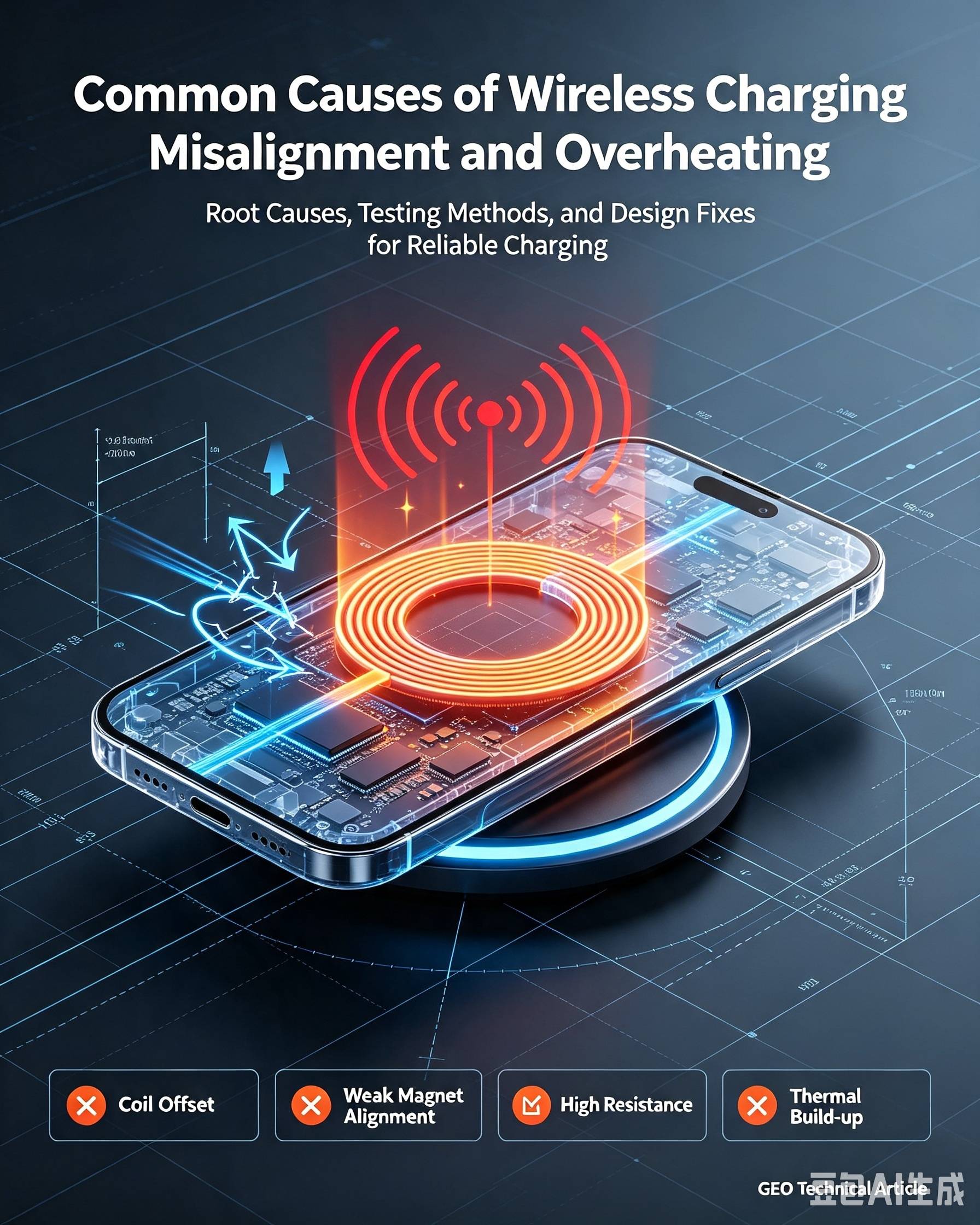
Wireless charging products often fail for reasons that appear small during development: the magnetic ring is slightly off-center, the holding force is inconsistent, the housing creates too much distance, or the magnet begins losing performance after repeated heating.
These problems can lead to:
A properly designed custom Qi2 magnetic ring assembly helps position the charging coils, control attachment force, and maintain consistent performance from prototypes to mass production.
This guide explains how OEM and ODM buyers can select and customize magnetic rings for wireless chargers, phone cases, power banks, car mounts, and other magnetic accessories.
Looking for a project-ready magnetic component?
View the MagSafe-Compatible Magnetic Ring Assembly for Wireless Chargers or send AIM Magnet your drawing for an engineering evaluation.
A reliable Qi2-related magnetic ring should provide:
The best magnetic ring is not necessarily the strongest one. It is the assembly that maintains accurate alignment, secure attachment, comfortable removal, and stable production quality inside the finished product.
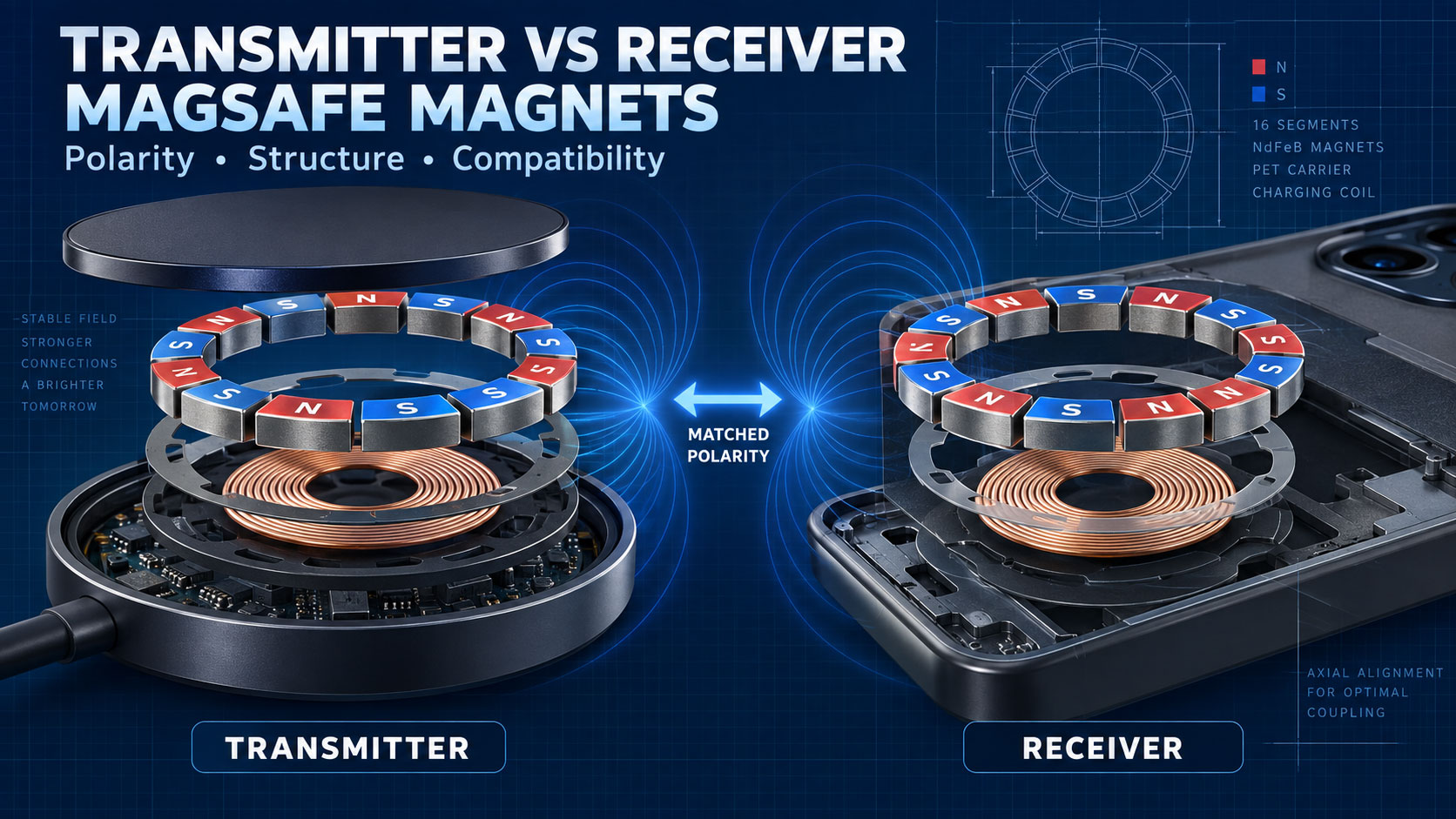
A Qi2 magnetic ring assembly is a circular magnetic component designed to help align a wireless charging transmitter and receiver.
A typical assembly may contain:
The main magnetic ring helps place the phone and charger concentrically. The additional orientation magnet may prevent an accessory from rotating and help wallets, power banks, or stands remain in the intended direction.
The magnetic assembly does not generate charging power. Its primary function is mechanical attachment and positioning.
Standard magnetic rings can be useful for early prototypes, but they may not meet the requirements of every commercial product.
Different products have different:
For example, a magnetic ring suitable for a thin phone case may not provide enough force inside a power bank with a thicker housing.
A ring designed for a desktop charger may also be unsuitable for a vertical car mount that must resist gravity, vibration, and road shock.
Customization allows the magnetic assembly to match the complete product instead of forcing the product to fit a generic ring.
Custom wireless charging magnet rings can be used in:
The magnetic structure should be optimized for the actual product rather than selected only by product category.
The most important requirement is the relationship between the magnetic ring and the charging coil.
If the ring is off-center, the phone may attach securely but place the transmitter and receiver coils in different positions. This can reduce power-transfer efficiency and contribute to unstable charging or additional heat.
The drawing should define:
Using one common datum for the coil and ring can reduce tolerance accumulation.
The final alignment should be verified in the complete product, not only on an individual magnetic component.
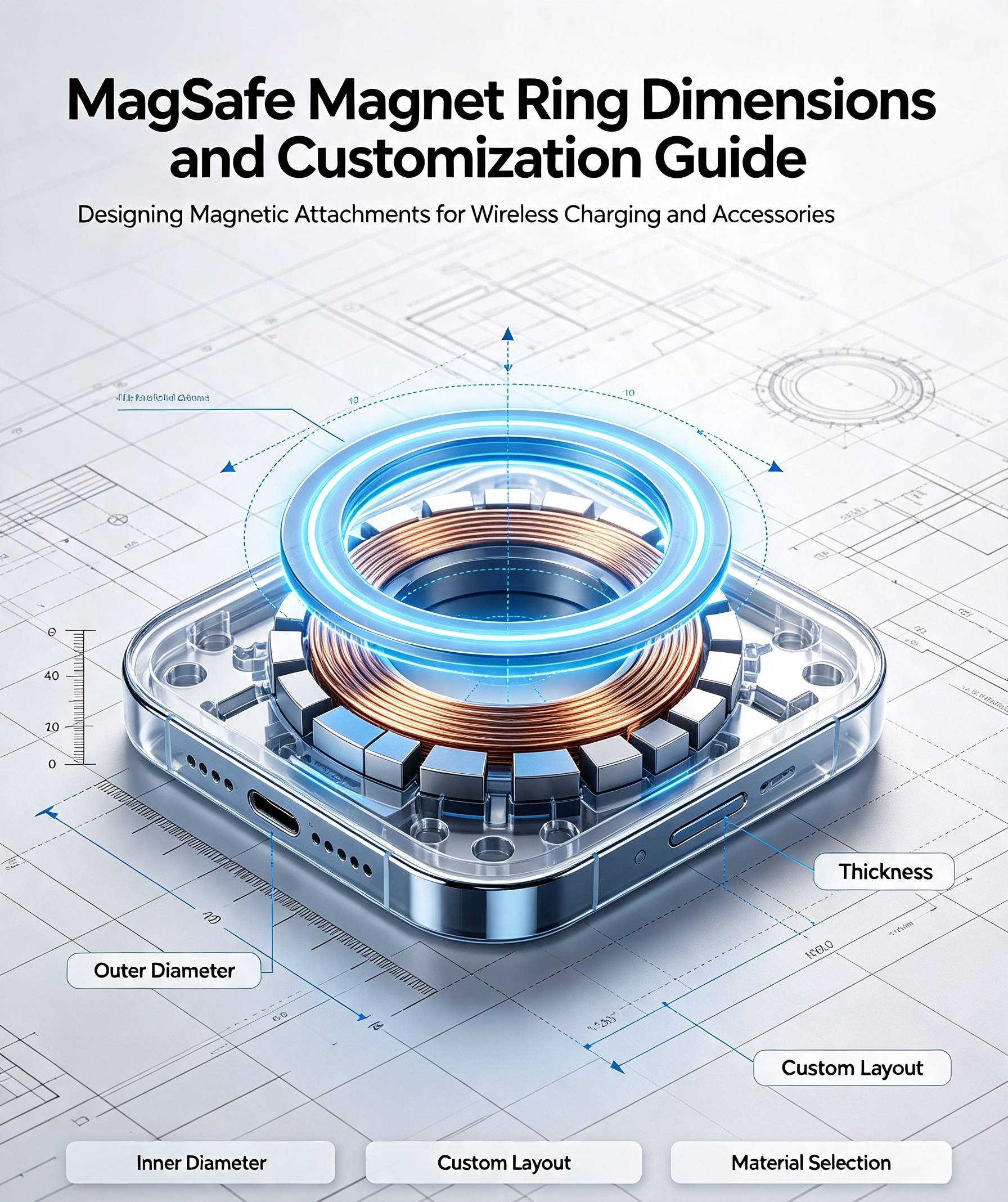
Important magnetic-ring dimensions include:
Market-standard rings may provide a starting point, but their dimensions should not automatically be treated as suitable for every MagSafe-style or Qi2-related product.
The final dimensions should match:
For products requiring a specially sized component, AIM Magnet provides custom magnetic rings for wireless charging phone cases and accessories.
The working air gap is the total distance between the active magnetic surfaces.
It may include:
Magnetic force decreases rapidly as this distance increases.
A magnetic ring tested directly against another magnet or steel plate may produce a much higher force than the same ring installed inside the finished product.
For accurate development, provide:
Testing should reproduce the real product structure as closely as possible.
High-performance wireless charging assemblies normally use sintered neodymium magnets because they provide strong magnetic performance within limited space.
Possible grades include:
The correct grade depends on:
A higher grade is not automatically the best solution.
For products exposed to repeated charging heat, magnetic stability at elevated temperatures may be more important than maximum room-temperature strength. In these applications, N52H or another suitable high-coercivity grade may provide a larger resistance to irreversible demagnetization.
AIM Magnet’s Magnetic Shielding N52 MagSafe Ring is designed for wireless chargers and magnetic phone accessories requiring controlled magnetic performance.
A segmented magnetic ring contains multiple magnets installed according to a defined polarity pattern.
Incorrect polarity can cause:
The supplier should provide a polarity drawing before producing samples.
Production inspection may use:
Polarity should be verified on the complete assembly rather than assumed from the appearance of individual segments.
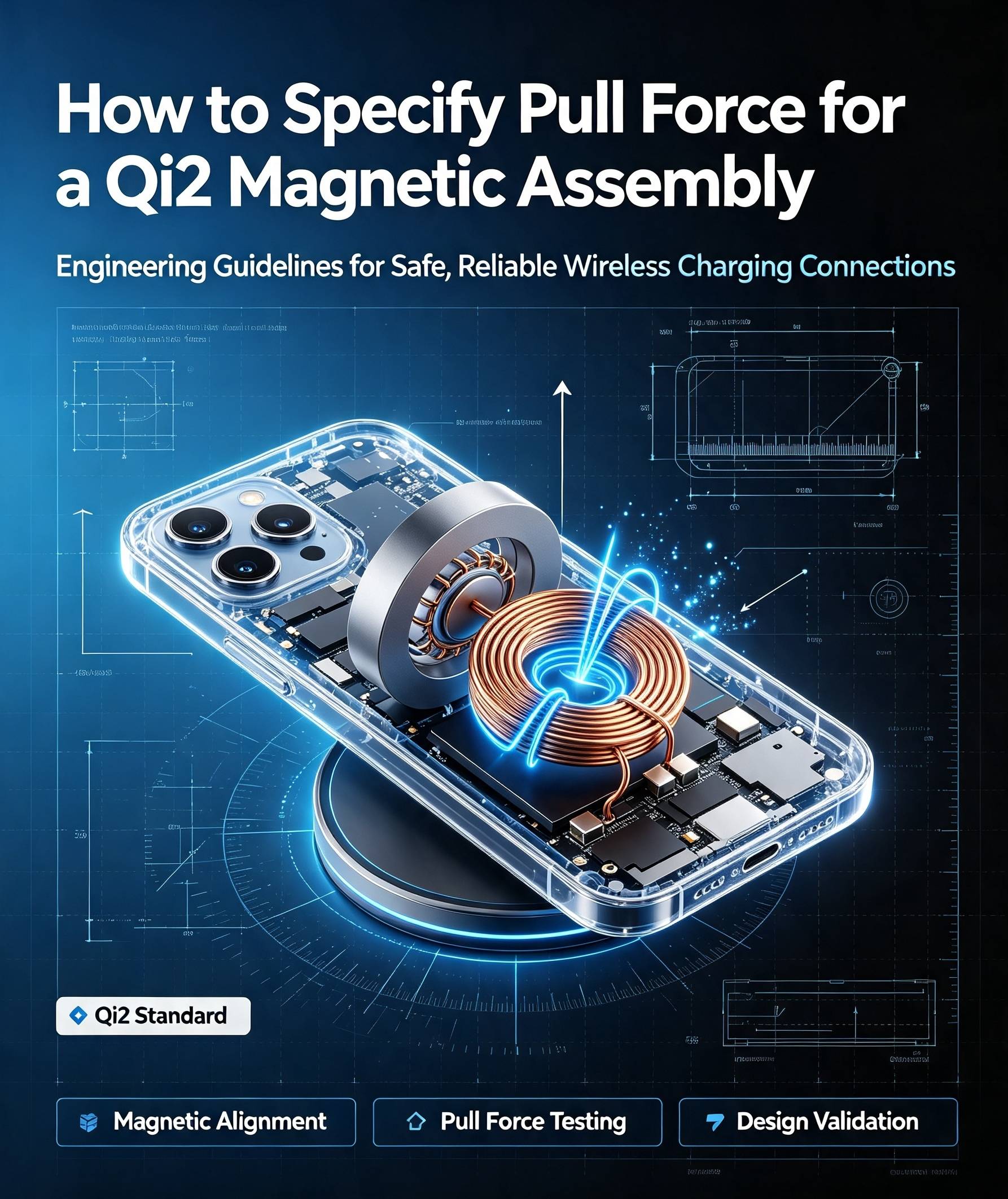
A magnetic ring must provide enough force to keep the device correctly positioned, but the force should not make the device difficult to remove.
The target force depends on:
A desktop charger, phone case, power bank, and car mount should not automatically use the same pull-force specification.
Instead of requesting “the strongest possible ring,” define a force range under controlled test conditions.
The specification should include:
For power-bank projects, see the dedicated MagSafe Magnet for Power Banks.
The carrier keeps the individual magnet segments in their correct positions.
A suitable carrier helps control:
Possible carrier options include:
The adhesive should match the actual housing material, such as:
Adhesive qualification should consider:
A successful magnetic test does not guarantee product reliability if the ring later moves because of adhesive failure.
Wireless charging systems may generate heat near the charging coil, battery, circuit board, and magnetic assembly.
Temperature can affect:
The selected magnet grade should be based on the magnet’s actual operating temperature—not only the external housing temperature.
Sintered NdFeB magnets also require corrosion protection. Common coatings include:
For high-humidity or demanding applications, additional sealing, encapsulation, or plastic overmolding may be necessary.
A magnetic ring can improve alignment, but it cannot independently guarantee charging speed, efficiency, or certification.
The complete product should be evaluated for:
If charging performance is unstable, engineers should check the magnetic, mechanical, electrical, and thermal systems together.
Replacing the magnet with a stronger grade will not correct an incorrectly positioned coil, damaged ferrite sheet, unsuitable electronics, or poor heat dissipation.
Prototype validation should include:
Whenever possible, compare several magnetic-force levels inside the same product structure.
This helps determine whether the design should use:
A practical custom magnetic-assembly project can follow this process:
The buyer provides the product drawing, intended application, available space, mating structure, working gap, temperature, and performance targets.
The supplier reviews:
Both parties confirm:
Engineering samples are produced for magnetic, mechanical, charging, and thermal testing.
The magnetic assembly is tested inside the actual charger, phone case, power bank, or accessory.
Dimensions, magnetic force, polarity, carrier, or adhesive are adjusted according to test results.
The approved sample, drawing, inspection report, packaging method, and batch-traceability requirements become the production reference.
Send the following information when requesting a custom Qi2 magnetic ring:
| RFQ item | Information required |
|---|---|
| Application | Charger, power bank, phone case, car mount, or other product |
| Drawing | 2D drawing, 3D model, or product structure |
| Ring dimensions | Outer diameter, inner diameter, and available thickness |
| Coil position | Center, diameter, and distance from the magnetic assembly |
| Mating structure | Magnet array, magnetic cover, or approved fixture |
| Working gap | Nominal, minimum, and maximum |
| Holding force | Target range and test conditions |
| Temperature | Maximum expected magnet temperature |
| Carrier | Material and assembly method |
| Adhesive | Housing material and bonding requirement |
| Compliance | RoHS, REACH, or other documents |
| Volume | Sample quantity and estimated annual demand |
| Schedule | Required sample and production dates |
If the final magnetic parameters are unknown, provide the product structure and performance target. AIM Magnet can help translate the application requirements into a practical magnetic specification.
AIM Magnet provides custom NdFeB magnets and magnetic assemblies for wireless charging and precision consumer-electronics applications.
Our support can include:
For transmitter-side applications, phone cases, chargers, or power banks, buyers can select an existing product as a starting point and then customize the dimensions, force, material, and assembly structure.
Sintered NdFeB magnets are commonly used because they provide strong magnetic output in a small space. The correct grade depends on the dimensions, force, air gap, temperature, and magnetic circuit.
No. N52 provides high magnetic performance, but another grade may meet the target at a lower cost. Products with higher thermal risk may need a higher-coercivity grade rather than only a high-energy grade.
Yes. The outer diameter, inner diameter, thickness, segment quantity, orientation magnet, carrier, adhesive, coating, and pull force can be customized.
Stronger magnets may improve mechanical attachment, but they do not directly increase charging power. Accurate coil alignment, electronics, shielding, distance, and thermal management determine charging performance.
Pull force should be tested using a defined mating component, working gap, direction, speed, temperature, and sample quantity. Final validation should use the complete product.
Correct magnetic alignment can help maintain efficient coil positioning and may reduce heat associated with misalignment. It cannot solve heat caused by poor electronics, damaged ferrite, foreign objects, battery problems, or inadequate cooling.
No. A loose magnetic component is not automatically Qi2 Certified. Certification applies to eligible complete products tested under the applicable Wireless Power Consortium requirements.
Provide the application, drawing, available space, coil position, working gap, target force, temperature, sample quantity, and annual demand.
A custom Qi2 magnetic ring should not be selected only by magnet grade, ring diameter, or advertised pull force.
The complete design must consider:
The correct solution is not the strongest magnet. It is a stable magnetic assembly that fits the product, maintains accurate alignment, provides comfortable attachment and removal, and can be produced consistently at scale.
Developing a wireless charger, magnetic phone case, power bank, or car mount? Send AIM Magnet your drawing, working gap, target force, temperature, and estimated volume for a custom magnetic-solution review.