How Do Wireless Charging Magnetic Rings Work?
MagSafe Magnetic Structures, Transmitter and Receiver Technologies Explained
Why does a phone snap securely onto a wireless charger with just a gentle touch? From magnetic power banks and car mounts to protective cases and accessories, magnetic alignment is making consumer electronics easier to use. Behind that convenience is a magnetic alignment array involving magnetic circuit design, pole configuration, precision machining, and assembly.
Buyers often ask why two N52 magnet assemblies have different holding forces, whether transmitter and receiver rings are interchangeable, and whether magnets affect charging efficiency. MSUPER explains the engineering principles and manufacturing considerations below.
01 | What Is a Wireless Charging Magnetic Ring? Does It Deliver Power?
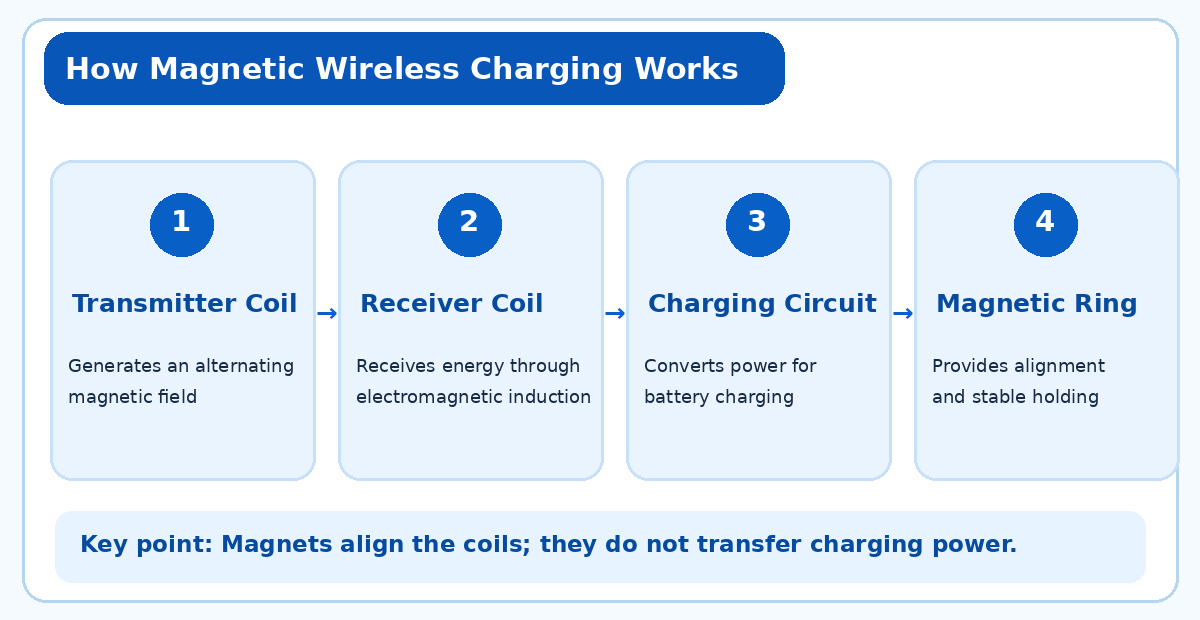
The primary function of a magnetic alignment ring is positioning and holding—not directly transferring electrical power. The transmitter coil in the charger produces an alternating magnetic field; the receiver coil in the phone receives energy by electromagnetic induction; receiver electronics condition that energy for battery charging. The magnetic array helps keep the two devices aligned and reduces displacement.
Why alignment matters: significant coil misalignment can weaken coupling, reduce efficiency and increase heat. Actual charging performance also depends on coil geometry, control electronics, foreign-object detection, thermal design and protocol compatibility. Magnetic alignment helps, but cannot alone determine charging efficiency.
02 | What Is the Difference Between Transmitter and Receiver Magnets?
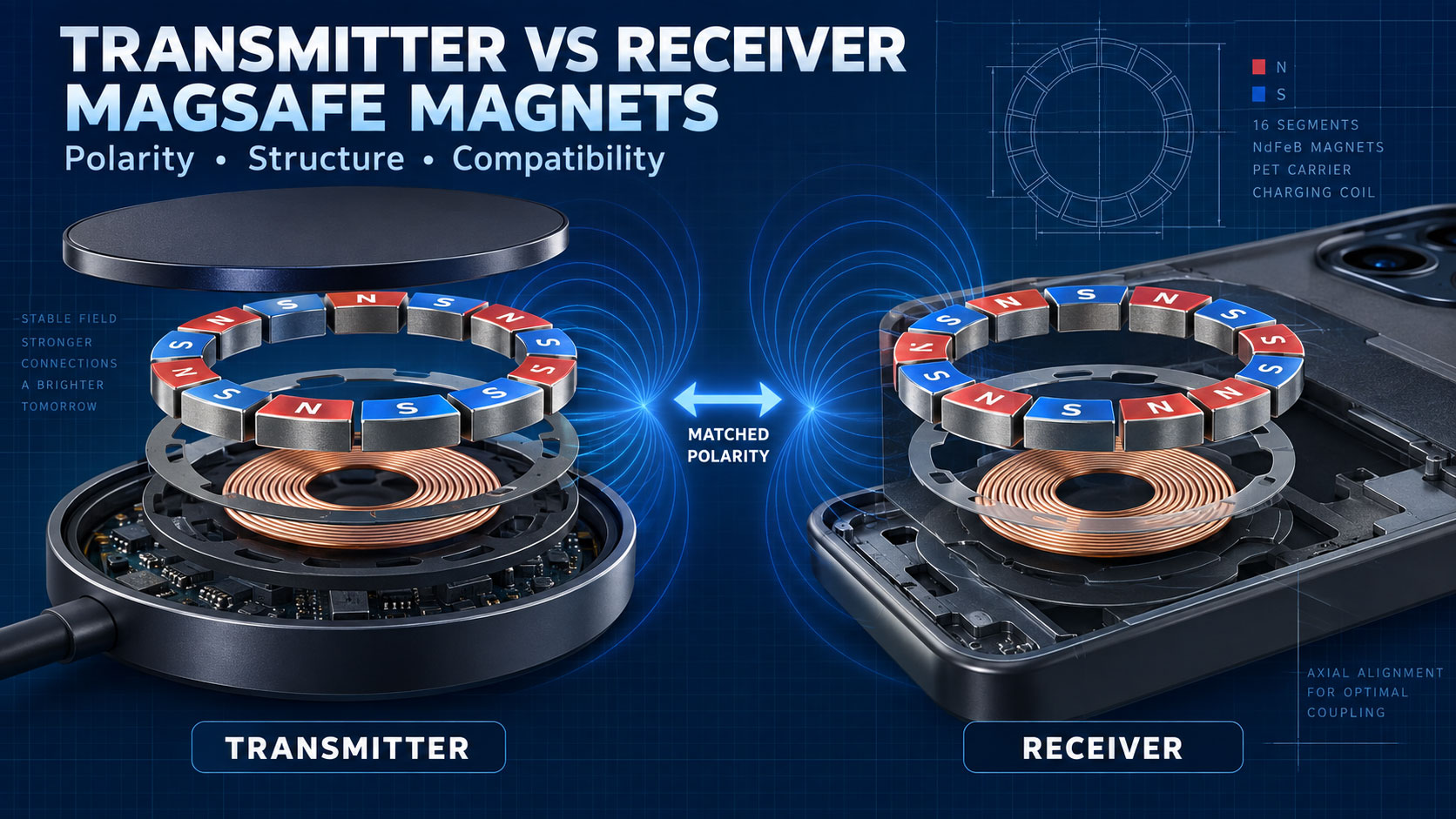
Magnetic charging assemblies are commonly grouped into transmitter-side magnets, receiver-side magnets and magnetic card-wallet magnets. Their designs are not universally interchangeable.
Transmitter-side magnets
Typical applications include wireless chargers, magnetic power banks, vehicle mounts and desktop stands. Assemblies may use segmented magnets, ferromagnetic backing rings or plates, and adhesive layers. The backing material shapes the magnetic flux path. Engineers must verify pole compatibility, assembly flatness, magnet gaps, adhesive thickness and overall dimensions.
Receiver-side magnets
These are found in phones, cases and other receiver-side accessories. Depending on the design, assemblies may include segmented magnets, Mylar film, double-sided tape, positioning film and optional ferromagnetic backing. Thickness, packaging space, surface protection and correct mating polarity are especially important.
Magnetic card-wallet magnets
Wallet magnets and auxiliary alignment features are tailored to the mating phone or case and the intended holding requirements. Not every wallet uses the same magnet layout.
|
Type |
Applications |
Typical structure |
Key requirements |
|
Transmitter |
Charger, power bank, car mount |
Segmented magnets, backing plate, adhesive |
Polarity, flatness, holding force |
|
Receiver |
Phone, phone case |
Segmented magnets, Mylar, double-sided tape |
Thickness, polarity, fit |
|
Card wallet |
Magnetic wallet and accessories |
Customized magnets and alignment features |
Holding stability, compatibility |
03 | Why Is Magnetic Polarity So Important?
A magnet has north and south poles. The transmitter and receiver must use complementary magnetic configurations to achieve the intended attraction and alignment. In one illustrative design, the transmitter mating surface has an inner south pole and outer north pole, while the receiver mating surface has an inner north pole and outer south pole. Some receiver assemblies also include an auxiliary tail magnet.
This is a design example—not a universal polarity specification for all MagSafe-compatible or Qi2 products. Always follow approved drawings, application requirements and applicable standards.
Planar two-pole vs. radial magnetization
Planar two-pole magnetization describes a specified inner/outer pole pattern on a face of the ring. Radial magnetization describes magnetization oriented radially. More complex multipole arrangements also exist. These approaches are not interchangeable without evaluating the geometry, tooling, magnetic circuit and assembly process.

04 | Why Can Two N52 Magnet Rings Have Different Holding Forces?
Magnet grade is only one factor. The six principal considerations are:
• Material grade: N35, N42, N48 and N52 offer different magnetic properties, but a higher grade does not guarantee greater assembly holding force.
• Thickness and dimensions: geometry and effective magnet volume affect field distribution; force does not increase without limit as thickness increases.
• Pole arrangement: segment count, orientation and polarity determine the magnetic field pattern.
• Backing-plate design: material, thickness, shape and contact quality influence flux distribution.
• Adhesive and air gaps: thick adhesive, lifted segments and uneven surfaces can reduce attraction.
• Test conditions: equipment, pull direction, contact area and test speed must be comparable across suppliers.
Procurement tip: specify the target holding force and test method, magnet dimensions, polarity drawing, backing structure and assembly tolerances—not merely the NdFeB grade.
05 | How Are Magnetic Charging Assemblies Manufactured?
1. Material selection and precision machining
Select NdFeB grade based on approved drawings; perform slicing, grinding, special-shape machining and dimensional inspection.
2. Surface treatment
Choose protective coatings such as Ni-Cu-Ni according to service conditions; inspect appearance, dimensions and specified coating properties.
3. Magnet positioning
Arrange segmented magnets with dedicated fixtures or automated equipment; prevent wrong orientation and uneven gaps.
4. Adhesive bonding and backing assembly
Bond magnets to backing plates, Mylar film and adhesive layers as specified. Maintain flatness and sufficient pressing time to prevent lifted segments.
5. Magnetization and polarity verification
Confirm fixture positioning, coil condition and process settings; check polarity and specified magnetic characteristics after magnetization.
6. Final inspection and packaging
Inspect dimensions, appearance, polarity, holding force and agreed specifications before packaging and delivery.
The manufacturing sequence varies: some assemblies are magnetized before bonding, while others are magnetized after assembly.
06 | How Is Consistent Manufacturing Quality Achieved?
• Flat bonding between magnets and backing plates; avoid adhesive buildup, lifted segments and warpage.
• Accurate pole positioning through fixtures and first-article checks.
• Reliable Mylar and adhesive bonding, with no exposed or detached magnets.
• Stable magnetization parameters and first-article polarity checks after coil or product changes.
• Final dimensional, cosmetic, polarity and holding-force inspection, with batch consistency monitoring.
These details may not be visible to end users, but they affect the reliability and experience of magnetic charging accessories.
07 | Frequently Asked Procurement Questions
Does a thicker ring always provide more holding force?
No. Force also depends on magnetic circuit design, backing material, air gap and the mating component.
Can a transmitter ring replace a receiver ring?
Not without design validation. Polarity, thickness, backing and adhesive structures can differ.
Does N52 automatically improve charging efficiency?
No. Charging efficiency also depends on coil design, circuitry, alignment and heat management.
Can every MagSafe ring be used in a Qi2 product?
No. Qi2 involves complete-system technical requirements and applicable certification. Shape or holding force alone does not establish compliance.
Can magnetic charging rings be customized?
Yes. Material grade, segment count, dimensions, polarity, backing plate, adhesive and assembly can be evaluated for each project.
08 | MSUPER: Precision Magnetic Assemblies for Wireless Charging
MSUPER is a brand of AIM Magnet Group, which has worked in sintered NdFeB magnets and magnetic assemblies since 2006. Its application areas include wireless chargers, magnetic power banks, car mounts and mobile accessories. Building on precision machining, in-house electroplating and magnetic assembly capabilities, MSUPER supports customers from material selection and structural evaluation to sampling and volume manufacturing.
A high-quality magnetic charging ring is about more than strong magnetism: it requires accurate polarity, a well-designed magnetic circuit, stable assembly and consistent quality. Share your drawings, specifications and application needs with the MSUPER team to discuss a tailored solution.
MSUPER — Custom Magnetic Solutions for Wireless Charging Applications. | www.msupermagnet.com